
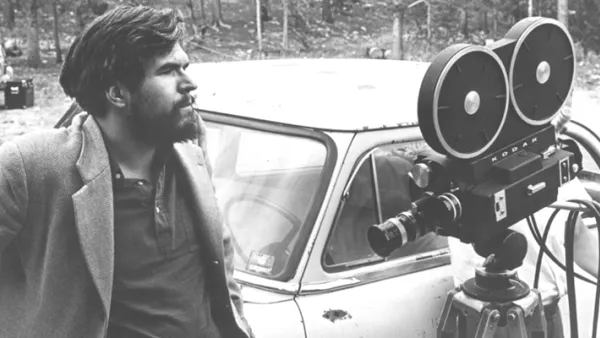

FMS assistant professor John Powers has been awarded a William H. Donner Moving Image Research Fellowship. The fellowship provides $2000 to one fellow per year to support research or creative work using archival moving image film and video collections in the University of Colorado Boulder Libraries’ Norlin Library, as well as other archival collections documenting the life and work of filmmakers. Support for this fellowship is graciously provided to the Libraries from the William H. Donner Foundation.
Dr. Powers is currently working on a second monograph, a biography entitled Stan Brakhage: An American Artist. The fellowship will allow him to study the James Stanley Brakhage papers, Cecile Starr papers, Ken and Flo Jacobs papers, Western Cine papers, Don Yannacito papers.
Stan Brakhage: An American Artist will be the first critical biography of Brakhage, cinema’s leading experimental filmmaker and one of the principal architects of cinematic modernism. Between 1952 and 2003, Brakhage completed nearly 400 films and 8 books of film criticism and theory. Dozens of his films, including Anticipation of the Night, Mothlight, Dog Star Man, and Scenes from Under Childhood, are acknowledged masterworks.
For an entire generation of filmmakers and viewers, the phrase “By Brakhage” exemplified the idea that cinema could be a personal expression on par with poetry, music, and painting. Brakhage’s career was forged in the crucible of the Beatknik 1950s and countercultural 1960s, but his continuous artistic reinvention prompted one of his peers to dub him “America’s Picasso.”
The techniques that he pioneered, most notably rapid editing, handheld camera, lens flares, and physical manipulation of the filmstrip, came to define experimental cinema, but they were also absorbed by advertising, music videos, and Hollywood. His lifelong crusade to transform vision––to “imagine an eye unruled by man-made laws of perception”––aligned cinema with revolutionary developments in cognitive science, psychoanalysis, education, and modern art and literature. His refusal of the separation between art and life, most directly evident in the many films that feature his first wife, Jane, and his five children, elevated the home movie to the status of art.

More inspired by modernist poetry and music than cinema, Brakhage’s cabin in the shadow of the Rocky Mountains became a site of pilgrimage where John Cage, Allen Ginsberg, Robert Creeley, Bruce Conner, and other key figures in 20th century art would share their work and discuss aesthetics and politics. At the same time, Brakhage’s nonstop lecturing and long teaching career at the School of the Art Institute of Chicago and the University of Colorado Boulder made him a public figure and ambassador for film art.


